The Age of Turning Away
In This Dose of Donalee,
The reflex we all share—and rarely examine.
Protests in the streets. Government leaders stepping down or being pushed out. Wars and unrest across borders. Institutions being questioned, traditions being dismantled, loyalties being renegotiated in real time. Scroll any feed for five minutes and you’ll find someone refusing something—a policy, a person, a pronoun, a premise, a paradigm.
And it’s not only the big, visible refusals. It’s the small ones, too. The eye-roll in the meeting. The unfollow. The “I’m not reading that.” The conversation that ends before it begins. The colleague who tunes out the moment a word lands wrong.
We are all doing it. Every one of us. And it’s easy to point the finger at the ones who are rejecting our thing—our politics, our language, our cause, our truth. But while one finger points at them, three are pointing back at you.
This is not only a communication and vocabulary problem. It’s a resistance problem.
And anything we resist fractures our energy and limits our potential.
So this week, let’s go deeper. Not into their rejection—into ours. Because the reflex to turn away is human, it’s universal, and it’s costing us more than we think.
The Thing We Don’t Say Out Loud
We reject across the board. And we do it fast.
We reject political posturing—from the other side. We reject AI language—because it feels cold, or fake, or like someone is selling us something. We reject LGBTQ+ language—because it asks us to update a map we thought we knew. We reject philosophy—because it feels abstract. We reject psychology—because it feels like excuse-making. We reject evolution—because it asks us to sit with uncertainty. We reject new spirituality—because it feels ungrounded. We reject tradition—because it feels outdated.
Different targets. Same reflex.
The trigger is real—and it’s ours. Let’s be honest about that before we ask anyone else to be.
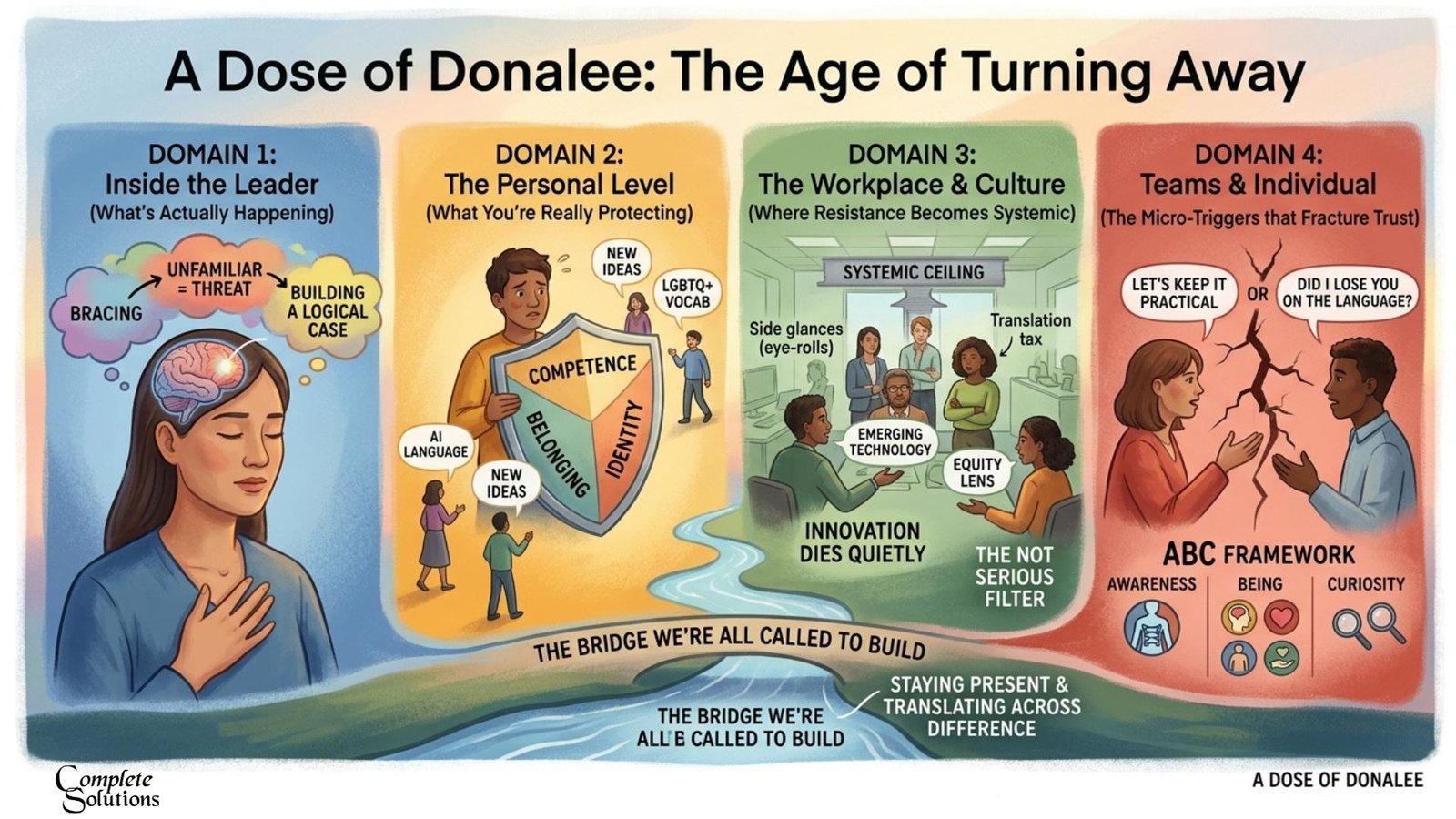
Domain 1: Inside the Leader
What’s actually happening when you reject what you don’t understand
You’re in a meeting. Someone says “energetic intelligence.” Or “let’s look at this through an equity lens.” Or “the model is hallucinating.” Or “we need to hold space for this.” And before you can stop yourself, your jaw tightens. Your chest closes. You think: Here we go. Fluff. Politics. Buzzwords. Not serious.
That bracing is not discernment. It’s protection.
Your brain has classified the unfamiliar as threat before your prefrontal cortex has had a chance to evaluate it. You’ve made a decision in 200 milliseconds—and then spent the next ten minutes building a logical case for it.
The honest truth for leaders: Refusing unfamiliar language feels like maintaining standards. Often it’s just maintaining comfort. And the cost is invisible but real—you stop hearing the signal because you’ve rejected the vocabulary carrying it.
Three usable tips:
- Name the brace before you name the judgment. When you feel the pull to dismiss, pause and locate it in your body. Jaw. Throat. Chest. Say silently: “I’m bracing.” That single act of naming interrupts the automatic rejection and returns choice to you.
- Ask the translation question, not the credibility question. Instead of “What does that even mean?” (which signals contempt), try: “Say more—what does that look like in practice?” You get the same information without triggering defensiveness in them or hardening your own position.
- Separate the vocabulary from the validity. A clumsy word can carry a precise insight. A polished word can carry nothing. Judge the substance, not the spelling.
Domain 2: The Personal Level
What you’re really protecting
When you shut down at unfamiliar language—political, cultural, technical, spiritual, philosophical—ask yourself: What am I protecting?
Usually it’s one of three things:
- Competence — “If I don’t know this language, I look behind.”
- Belonging — “If I accept this, am I joining a tribe I don’t respect?”
- Identity — “This language represents a worldview I’ve decided isn’t mine.”
None of these are shameful. They’re human. But here’s the cost: you stop learning from anyone who speaks differently than you do. And the people most likely to have something you need are usually the ones whose language feels strangest.
The personal practice: Next time you feel triggered, don’t argue with the trigger.
Use it. Ask: “What is this reaction telling me about what I’m afraid of losing?”
That’s the door in.
Domain 3: The Workplace & Culture
Where resistance becomes systemic
A single leader’s resistance is a personal pattern. A whole culture’s resistance is a structural ceiling.
Watch for these signals:
- The eye-roll economy. Side glances in meetings when someone uses language that doesn’t fit the room—too “woo,” too “woke,” too “tech,” too “academic.” The speaker learns to code-switch or go quiet. Innovation dies quietly.
- The translation tax. The person bringing new language is expected to do all the work of bridging—explain, defend, simplify—while the receiving side does none. That’s not communication; that’s a toll.
- The “not serious” filter. New language gets dismissed as unserious before it’s evaluated on merit. AI fluency gets dismissed by traditionalists. Equity language gets dismissed by technocrats. Philosophy gets dismissed as navel-gazing. Every dismissal costs the organization something it can’t see.
Culture-level tips:
- Make translation a shared responsibility. When someone introduces unfamiliar language, the room’s job is not to reject it—it’s to ask for the plain-language anchor. “What does that mean in practice?” becomes a norm, not a challenge.
- Reward the bridge-builders. The people who can speak across divides—technical and human, traditional and emerging, conservative and progressive—are your most valuable communicators. Notice them. Promote them. They’re the ones who make the room expand.
- Audit your meeting norms. If new ideas die in the room because of how they’re worded, that’s a culture problem wearing a vocabulary costume.
Domain 4: Teams & Individual Relationships
The micro-triggers that fracture trust
This is where it gets personal—and where it matters most.
The colleague who tunes out when you use a new framework. The manager who says “let’s keep it practical” as a way of saying “let’s keep it familiar.” The family member who changes the subject when politics comes up. The friend who goes quiet when you mention a book that challenged them.
Each of these is a small fracture. Multiply them across a year and you have teams that stop bringing new ideas, families that stop talking honestly, and a culture that mistakes silence for harmony.
The relational practice — my ABC framework:
A — Awareness. Notice the subtle bracing before the dismissal. In yourself and in others. When you see someone check out, don’t assume disinterest—ask “Did I lose you on the language?” Naming it reopens the door.
B — Being. Am I all in my head—or am I bringing all of me present to meet this? IQ (head/analysis), EQ (heart/emotion), PQ (body/somatic), SQ (spirit/meaning). New language requires full presence, not just cognition. When we meet only from the head, we call unfamiliar “wrong” instead of “not yet mapped.” When we bring all four, we can stay in the conversation without abandoning discernment.
C — Curiosity. Can I stay curious and engaged long enough to translate? Curiosity is not agreement. It’s staying in the room without abandoning your standards. Translation is not dilution. It’s how two people with different maps find each other.
One usable move for teams: At the start of any meeting where new concepts will be introduced, say: “If I use a word that doesn’t land, flag it. I’d rather translate than lose you.” That one sentence changes the relational contract.
The Bridge We’re All Called to Build
Here’s what I know after decades in this work:
We are not being asked to abandon our language. We are being asked to build bridges with it.
The leader who can speak AI fluency and human language. The team that can hold new vocabulary and legitimate critique. The culture where curiosity outpaces contempt.
That’s not a vocabulary skill. That’s a leadership capacity.
And it’s trainable.
Where This Leads: Leadership Development Is the Answer
Everything I’ve described here—the bracing, the turning away, the fractures in teams, the culture ceiling—these are not solved by a glossary or a communications memo. They’re solved by developing leaders who can hold complexity, stay present, and translate across difference.
That’s the work I do. And it’s the work that changes rooms.
If you’re a leader who:
- Feels the rub between staying current and staying true
- Watches new ideas die because of how they’re worded
- Wants to build a team culture where curiosity outpaces contempt
- Needs to integrate change without fracturing your people
—then let’s talk. My leadership training and development programs are built to close exactly this gap: the gap between the language people speak and the language the future requires.
DM me “BRIDGE” and I’ll send you details on the next cohort.
Because if we only speak in the language of the room, the room never expands.
And I’d like to expand it with you.
This Week’s Practice
Pick one conversation this week where you feel triggered by unfamiliar language—political, cultural, technical, or personal.
Before you dismiss it, do this:
- Notice where you brace in your body.
- Ask what you’re protecting.
- Stay curious for one more question than you normally would.
Then write to me and tell me what happened. I read every reply.
With curiosity and fire,
Donalee
P.S. The LinkedIn post that started this—”Are you triggered by language outside your limited vocabulary?”—is still getting comments. If you haven’t added your perspective, I’d love to hear it. And if this newsletter resonated, forward it to one leader who needs to read it.
Anything we resist fractures our energy and limits our potential. Use your triggers. Don’t let them use you.
Unleash Your Power Within
Let’s Stay Connected!
Receive wisdom & inspirational ideas in your inbox.